Not all investment income is created equal.
Some income you control. Some shows up in your account whether you want it or not. And when tax season rolls around, the difference between capital gains and dividends can start to matter a lot more than it did when you first hit “buy.”
Whether you’re investing through a TFSA, RRSP, or taxable account, understanding the difference isn’t just a tax lesson, it’s a strategy decision. One that affects how fast your wealth compounds and how much of it you actually keep.
Let’s break it down in real terms.
What Are Capital Gains?
Capital gains happen when you sell an investment for more than you paid.
Buy at $30, sell at $50, and you’ve made a $20 capital gain per share.
A few things to know:
- You’re only taxed when you sell (realized gains)
- In a taxable account, only 50% of the gain is taxable in Canada
- In a TFSA, you pay zero tax on gains
- In an RRSP, your gains grow tax-free, but you’re taxed on the full withdrawal later
Personally, I like capital gains when I’m holding long-term growth stocks or ETFs I don’t plan to sell for years. The deferral of tax, and the ability to choose when to trigger it, makes this one of the cleanest forms of investment income.
What Are Dividends?
Dividends are payments that companies make to shareholders, typically every quarter. Think of them like a cash thank-you for holding the stock, common with banks, utilities, and mature blue-chip companies.
Key things to note:
- In taxable accounts, dividends are taxed in the year you receive them
- Canada offers a dividend tax credit, which softens the blow, especially for eligible dividends from Canadian companies
- In a TFSA, dividend income is completely tax-free
- In an RRSP, dividends grow tax-free, but are fully taxed when withdrawn
So while dividends provide regular cash flow, they’re less flexible from a tax perspective, especially in taxable accounts. That’s why many investors prioritize holding dividend stocks inside a TFSA or RRSP.
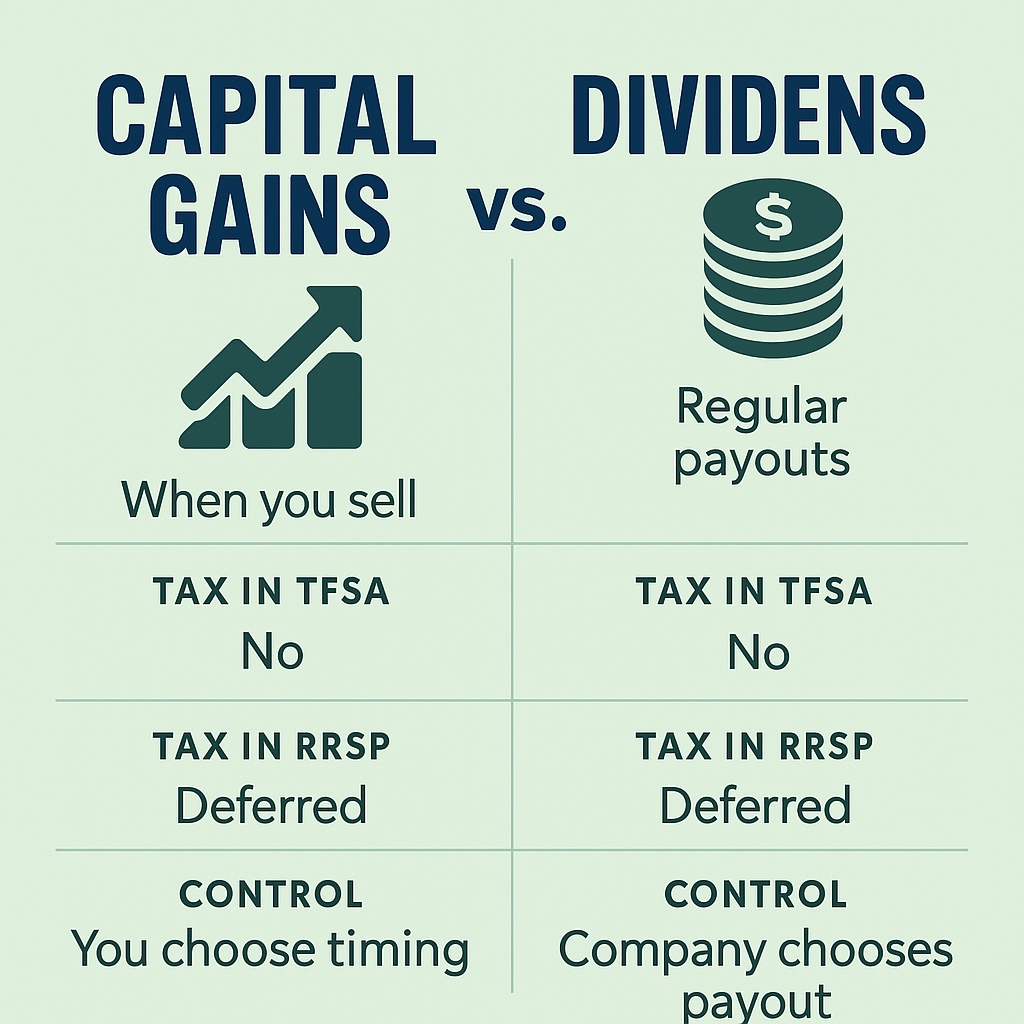
Key Differences at a Glance
| Feature | Capital Gains | Dividends |
|---|---|---|
| Timing | When you sell | Regular payouts |
| Tax in TFSA | No | No |
| Tax in RRSP | Deferred | Deferred |
| Taxable Account | 50% taxed | Dividend tax credit |
| Control | You choose timing | Company chooses payout |
Which One Should You Prioritize?
It depends on your goals.
- Capital gains give you more control. You decide when to sell, and they’re tax-efficient in taxable accounts. Great for long-term growth strategies.
- Dividends provide consistent income. They’re ideal if you want cash flow, are in retirement, or prefer a more hands-off, slow and steady approach.
In reality, most well-rounded portfolios have both. Even within ETFs, you’ll see a mix of dividend payers and capital appreciation plays.
If you use a platform like Wealthsimple, you can screen ETFs and stocks by dividend yield or growth focus, making it easy to tilt your portfolio toward your preferred strategy.
What I Personally Do
I’m a long-term investor who likes to keep things tax-efficient. Here’s how I tend to structure things:
- 70% in growth-oriented stocks and ETFs (focus on capital gains)
- 30% in dividend payers, mostly inside my TFSA
- I reinvest all dividends automatically inside the TFSA, so it compounds quietly
I like having the option of income, but I want most of my returns to be deferred or tax-free while they grow.
If you’re not sure what fits you best, this kind of blended approach is a solid default.
So, capital gains vs. dividends, which one is better?
It’s not about one being universally better. It’s about how each fits your goals, your timeline, and your tax situation.
- If you want control and long-term growth, lean toward capital gains
- If you want steady cash flow and simplicity, consider dividend payers
Either way, start with tax-advantaged accounts like a TFSA or RRSP to maximize the benefits. (If you’re unsure which one, check out our TFSA vs RRSP article.)
“Look at your current investments: are they more growth-oriented or dividend-paying? And is that aligned with your goals? You don’t need a perfect answer, just a conscious one.”
Smart money moves start with clarity, and this is a great place to build yours.